
If you are being treated for acne or rosacea, there is a good chance your provider has mentioned clindamycin phosphate. It is the most widely used topical antibiotic for acne, and it comes in several forms. Two of the most common are a gel and a topical solution.1
Both contain the same medication at the same strength, so the real differences come down to how each one feels on your skin, how often you apply it, and which skin types it tends to suit. Here is how they compare, so you can have a more informed conversation with your provider.
“For most patients the choice comes down to skin type and routine. The solution can feel lighter on oily skin, while the gel tends to be gentler on skin that is dry or sensitive. Whichever form you use, pairing it with benzoyl peroxide helps it keep working,” advises Dr. Fick, chief medical officer for RedBox Rx’s parent company, Hy-Vee, Inc.
Key Takeaways
Clindamycin phosphate gel and topical solution contain the same antibiotic at the same 1% strength, and research shows they work equally well for acne.
The gel is water-based and tends to be gentler, making it a common choice for dry, sensitive, or combination skin.
The topical solution is alcohol-based and more drying, which can make it a better fit for oily skin.
Topical clindamycin phosphate is FDA approved for acne. It is sometimes prescribed off-label for rosacea, though research on that use is mixed.
Providers usually pair clindamycin with benzoyl peroxide to help prevent antibiotic resistance.
What is topical clindamycin phosphate?
Clindamycin phosphate is a prescription antibiotic that you apply directly to your skin. It belongs to a class of medications called lincomycin antibiotics, and it is available as a generic and under several brand names.2
How It works
Clindamycin phosphate is inactive until it is applied to your skin, where it is quickly converted into clindamycin, its active form. It then slows or stops the growth of the bacteria that cause acne and helps calm the redness and swelling of inflamed breakouts.
Only a very small amount of the medication reaches the bloodstream when it is used on the skin.3,4,5
Uses
Topical clindamycin phosphate is FDA approved to treat acne vulgaris, the most common type of acne. It is generally prescribed for adults and children 12 years of age and older.
Providers also prescribe it off-label for other skin conditions, most often rosacea. Other off-label uses include perioral dermatitis and hidradenitis suppurativa, though the research supporting these uses is more limited.6,7,8
Forms
Topical clindamycin phosphate comes in several forms, including:
Topical solution (liquid), including single-use pledgets (premoistened swabs)
Lotion
Foam
The gel, solution and lotion all contain 1% clindamycin. Clindamycin is also available in combination products that pair it with other acne medications.9,10
Side effects
Topical clindamycin is generally well tolerated. The most common side effects show up where it is applied and include:11,12
Dryness
Burning or stinging
Itching
Peeling
Redness
Less often, people develop an allergic skin reaction (contact dermatitis), eye pain, or a type of skin infection called gram-negative folliculitis.
Because a small amount is absorbed through the skin, topical clindamycin can rarely cause colitis, a serious inflammation of the colon. Stop using it and contact your provider right away if you develop severe, watery, bloody diarrhea, or stomach cramps. Topical clindamycin is not recommended for people with a history of Crohn’s disease, ulcerative colitis, or colitis caused by antibiotics.
If you are pregnant or breastfeeding, talk with your provider. Topical clindamycin is not considered likely to harm a developing baby, but your provider can help you weigh your options.13,14,15
How effective is topical clindamycin phosphate?
For acne
Topical clindamycin has been used to treat acne for decades and is backed by a large body of research. In a 12-week study of 592 people with mild to moderate acne, clindamycin gel applied once a day and clindamycin solution applied twice a day each reduced inflammatory breakouts by about 65%. There was no meaningful difference in results between the two forms.16,17
Clindamycin works best as part of a combination treatment plan, though. The American Academy of Dermatology recommends topical antibiotics for acne but advises against using them on their own, since acne bacteria can become resistant over time. Pairing clindamycin with benzoyl peroxide improves results and helps prevent resistance.18
Improvement is gradual. It can take four to six weeks of consistent use before you notice a difference.19
For rosacea
Clindamycin is not FDA approved for rosacea, and research on this use is mixed. A small 1993 study of 43 people found that clindamycin lotion worked about as well as oral tetracycline (an antibiotic pill) and was better at clearing pus-filled bumps.20 However, two larger trials involving more than 600 people with moderate to severe rosacea found that clindamycin cream and gel were no more effective than an inactive cream or gel.21
Because of this, clindamycin is not considered a first-line rosacea treatment. Topical medications such as azelaic acid, metronidazole, and ivermectin are typically tried first for the bumps and redness of rosacea. Your provider may still consider clindamycin as part of a personalized plan, particularly when rosacea causes acne-like bumps and pimples.22
What is clindamycin phosphate gel?
Clindamycin phosphate gel is a water-based gel that is thickened with polymers rather than alcohol, which makes it less drying than the topical solution. In head-to-head research, the gel was just as effective as the solution and caused slightly fewer skin reactions.23,24,25
Best for
Because it is alcohol-free, the gel suits most skin types and is often the better choice for people with dry or sensitive skin.26
How to use
Your provider will tell you how often to apply the gel. Clindagel® is applied once a day, while Cleocin T® gel and most generic gels are applied twice a day, in the morning and evening.27
To apply clindamycin gel:28,29
Gently wash the affected area with a mild cleanser and warm water, then pat dry.
Apply a thin layer to the entire area where breakouts appear, not just to individual pimples.
Avoid your eyes, mouth, and the inside of your nose.
Wash your hands after applying.
Apply it at around the same time each day.
Keep using the gel even after your skin starts to clear. Stopping too soon can cause breakouts to come back.30
Common brand names include:
Clindagel®
Cleocin T® gel
What is clindamycin phosphate topical solution?
Clindamycin phosphate topical solution is a thin liquid made with water and isopropyl alcohol, with alcohol making up about half the formula. It comes in a bottle, often with an applicator tip, or as single-use pledgets.
The alcohol helps the solution spread easily and dry quickly, but it can also be drying and irritating, especially on sensitive skin.31,32,33,34
Best for
The topical solution tends to work best for people with oily skin, since its drying effect can help skin feel less greasy. Its thin, liquid texture also spreads easily, including over areas with hair.
If your skin is dry or sensitive, the solution may cause more stinging or dryness than the gel.35,36,37
How to use
Clindamycin topical solution is usually applied twice a day, in the morning and evening.38
To apply clindamycin topical solution:39,40
Wash the affected area gently and pat dry. Wait about 30 minutes after washing or shaving before applying, since the alcohol can sting freshly washed or shaved skin.
If your bottle has an applicator tip, dab it onto your skin rather than rolling it on like a deodorant.
If you use pledgets, use each one only once and then throw it away. You can use more than one pledget to cover the area.
Apply a thin layer over the entire affected area.
Keep it away from your eyes, mouth, and any broken skin. The alcohol can burn your eyes, and the solution has an unpleasant taste.
The solution is flammable, so avoid open flames and smoking while applying it and right after.
Common brand names include:
Cleocin T®
Cleocin T® pledgets
Affordable online acne and rosacea treatment.
Consult online with a skincare specialist and get acne or rosacea prescriptions for less.
Get StartedWhat are the differences between clindamycin phosphate gel and topical solution?
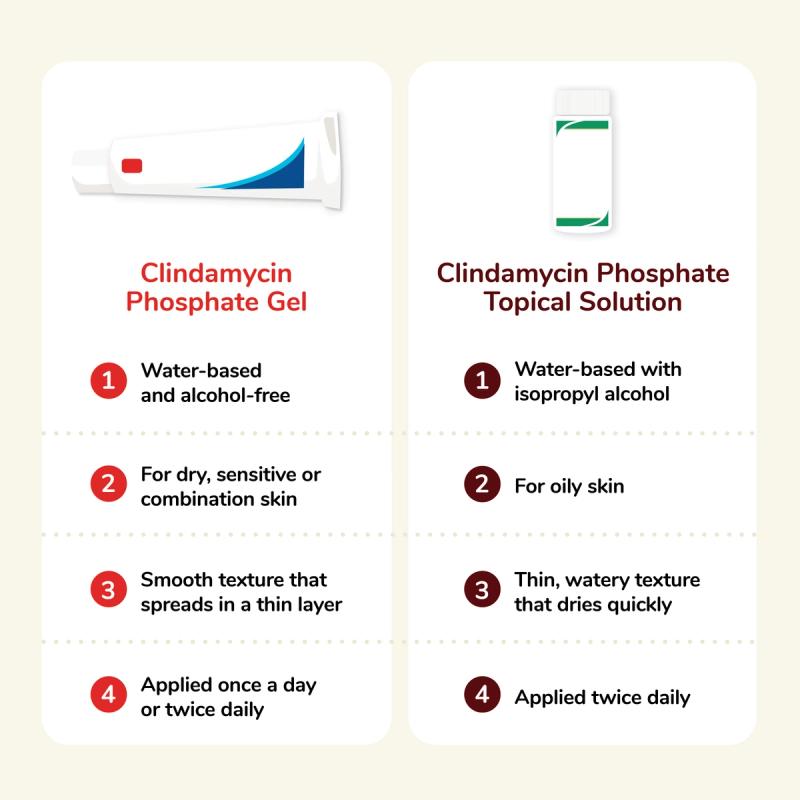
Because the gel and topical solution contain the same medication at the same strength, they have more in common than not, and research has found them equally effective for acne.41 The differences come down to the formula, how often you apply it, and how it feels on your skin.
Base and formulation
Clindamycin gel is water-based and alcohol-free. Clindamycin topical solution is made with water and isopropyl alcohol. Both contain 1% clindamycin.42
Dosing schedule
The topical solution is applied twice a day. Depending on the brand, the gel is applied either once a day (Clindagel®) or twice a day (Cleocin T® gel and most generics).43
In a 12-week study, once-daily Clindagel® worked as well as twice-daily Cleocin T® gel and was better tolerated.44 If a simpler routine matters to you, ask your provider whether a once-daily gel is an option.
Skin type
The gel is generally gentler and a better match for dry, sensitive or combination skin, while the solution’s drying effect tends to suit oily skin. In a large study comparing the two, the gel caused slightly fewer skin reactions.45,46,47
Absorption and texture
With either form, only a very small amount of clindamycin reaches the bloodstream. What you will notice more is the texture. The gel feels smooth and spreads in a thin layer. The solution feels thin and watery and dries quickly as the alcohol evaporates, but it may sting or feel tight on sensitive skin.48,49,50
Cost and availability
Both forms require a prescription and are widely available as lower-cost generics. Prices vary by pharmacy, brand and package size, and brand-name versions typically cost more. Through RedBox Rx, clindamycin gel or solution prescriptions start at $20 per month after a $25 online consultation, and no insurance is required.
Where can I buy clindamycin phosphate gel and clindamycin phosphate solution?
Both clindamycin phosphate gel and topical solution require a prescription from a licensed healthcare provider. Once you have a prescription, you can fill it at most retail pharmacies or through an online provider.
With RedBox Rx, you can complete a quick online assessment for acne or rosacea and a U.S. licensed medical provider will determine if a prescription is right for you. Prescriptions ship directly to your door.
Is topical clindamycin phosphate available over the counter?
No. In the United States, topical clindamycin is available only with a prescription.51 If you suffer from consistent acne breakouts, an online assessment and consult from RedBox Rx can help you find the right treatment.
Can I combine topical clindamycin phosphate with other treatments?
Yes. In fact, topical clindamycin is usually prescribed alongside other acne treatments. Combining medications that work in different ways improves results and helps keep bacteria from becoming resistant to clindamycin. Combination products that put clindamycin and a second ingredient into a single gel can also make your routine simpler.52
Benzoyl peroxide
Benzoyl peroxide is the most common partner for clindamycin. It kills acne bacteria in a different way, and bacteria do not become resistant to it, so it helps protect clindamycin’s effectiveness. In one 16-week study, levels of clindamycin-resistant bacteria rose sharply in people using clindamycin alone but dropped in people using a clindamycin and benzoyl peroxide gel.
Clindamycin and benzoyl peroxide are available together in combination gels such as BenzaClin®, Duac®, and Acanya®. Keep in mind that benzoyl peroxide can bleach hair, towels, and clothing.53,54,55,56
Tretinoin
Tretinoin is a prescription retinoid that helps unclog pores and prevent new breakouts. Clindamycin and tretinoin are available together in a once-daily gel (Ziana® and generic versions) that is applied at bedtime. Tretinoin can make your skin more sensitive to the sun, so wear sunscreen every day.57
The American Academy of Dermatology also recommends adding benzoyl peroxide when using a retinoid and a topical antibiotic together to help prevent resistance.58
Adapalene
Adapalene is another retinoid that helps keep pores clear. In a 12-week study of 249 people, adding adapalene gel to clindamycin led to significantly greater improvement than clindamycin alone, with results seen as early as week four.
Clindamycin is also combined with adapalene and benzoyl peroxide in Cabtreo®, the first FDA-approved three-in-one topical acne treatment. It is applied once a day.59,60,61
Azelaic acid
Azelaic acid calms inflammation, helps unclog pores, and can fade the dark spots acne sometimes leaves behind. In the U.S., a 20% cream is FDA approved for acne and a 15% gel is FDA approved for rosacea. Research suggests that combining azelaic acid and clindamycin can reduce breakouts more than either one alone.
Because azelaic acid is a first-line rosacea treatment, a provider may pair it with clindamycin or recommend it instead for people with rosacea.
Always check with your provider before combining treatments. Using several products at once can increase dryness and irritation, and your provider can help you build a routine your skin can handle.62,63,64,65,66
How to choose between clindamycin phosphate gel and clindamycin phosphate solution
Both forms work equally well for acne, so the right choice depends on your skin and your routine. Talk with your healthcare provider to determine which option is the better fit for you. Factors to consider include:
Your skin type: If your skin is oily, the alcohol-based solution may feel lighter and help control shine. If your skin is dry, sensitive, or easily irritated, the water-based gel is usually more comfortable.
Your routine: Some gels only need to be applied once a day, while the solution is applied twice a day. A simpler routine can make it easier to stay consistent.
The area you are treating: The thin solution spreads easily, including over areas with hair.
Other treatments you use: Benzoyl peroxide and retinoids can be drying. If you are using either one, a gentler gel may help limit irritation.
The condition being treated: Clindamycin is FDA approved for acne. If you have rosacea, your provider may recommend a different first-line treatment or use clindamycin as part of a broader plan.
If one form irritates your skin or does not fit your routine, let your provider know. Switching from the solution to the gel, or the other way around, is a simple change.
How RedBox Rx can help
RedBox Rx makes receiving treatment for acne and rosacea easy and affordable, including clindamycin phosphate gel or clindamycin phosphate solution.
Benefits of RedBox Rx include:
Clindamycin prescriptions starting at $20 per month.
$25 consultation with a U.S. licensed medical provider.
No insurance required. HSA and FSA eligible.
No office wait times or scheduling issues typical with physical medical practices.
FREE shipping directly to you.
One-time, monthly, and quarterly subscriptions available.
Get started on your journey toward better skin with our online assessment for acne or rosacea.