
The world of skincare can be overwhelming. That’s why we’ve pulled together a review of the science behind two powerful treatment options for acne, anti-aging, and wrinkles: adapalene (Differin®) and tretinoin (Retin-A®). Both are retinoids, a class of vitamin A derivatives used to treat a wide spectrum of skin conditions, including acne, wrinkles, and hyperpigmentation (age or sunspots). Both have scientific support for clearing breakouts and softening reducing fine lines, wrinkles, and sun damage., But which one is right for you?
“Patients ask me which retinoid is best. The honest answer is that the best one is the one your skin tolerates and that you will actually use every night.” - Dr. Fick, chief medical officer for RedBox Rx’s parent company, Hy-Vee, Inc
Learn about both acne and anti-aging treatments, how they compare, and the advantages or disadvantages to consider for your skincare needs.
Key Takeaways
Adapalene (Differin®) is a gentler retinoid that is FDA-approved to treat acne and used off-label for signs of aging. The 0.1% gel is available over the counter, and it typically takes eight to 12 weeks to improve acne and several months to soften wrinkles.
Tretinoin (Retin‑A®) is a prescription-only retinoid with decades of evidence behind it for acne and anti-aging. It typically takes eight to 12 weeks to improve acne and up to several months to soften wrinkles.
Your primary skin goals, skin type, and sensitivity can help determine which treatment may be right for you.
What is adapalene (Differin®)?
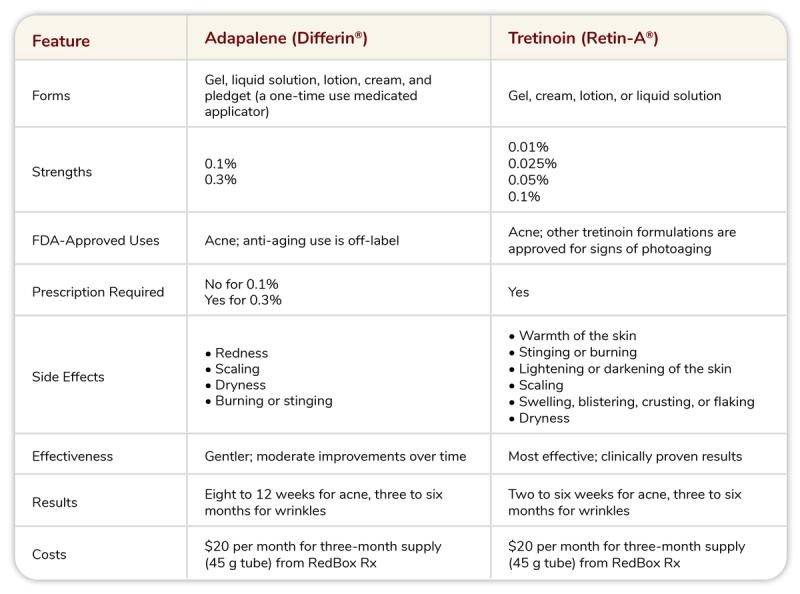
Adapalene, the generic version of Differin®, belongs to a class of medications called retinoids. It is FDA approved to treat acne, and dermatology providers also use it off-label to address wrinkles, hyperpigmentation, and other signs of aging.1
How it works
For acne, adapalene works by keeping pores clear and stopping pimples from forming under the surface of the skin. It also reduces the inflammation and swelling that make breakouts red and sore.2 Retinoids like adapalene soften fine lines and wrinkles by increasing collagen production. They also stimulate new blood vessel growth in the skin, which can improve skin color and fade dark spots.3
Forms and strengths available
Adapalene comes in multiple forms, including gel, liquid solution, lotion, cream, and pledget (a one-time use medicated applicator). The over-the-counter version is a 0.1% gel. Every other form, along with the stronger 0.3% strength, is available by prescription only.4
Side effects
Side effects of adapalene for treatment of acne or anti-aging include:5
Redness
Scaling
Dryness
Burning or stinging
What is tretinoin (Retin-A®)?
Tretinoin (Retin-A®) is a topical skin treatment that also belongs to the retinoid group of medications. It is one of the most studied options for both acne and signs of aging. Retin-A® is FDA approved to treat acne, while other tretinoin formulations are approved to improve the fine wrinkling, dark spots, and rough skin caused by the sun.6
How it works
Tretinoin works by speeding up the skin cell turnover process, resulting in the growth of new, healthier skin.7 For acne, that faster turnover helps keep pores from clogging so fewer blemishes form. For aging skin, it may reduce fine wrinkles, though it will not erase them or fully repair sun damage. Providers also use it to improve dark spots and the rough texture left behind by sun exposure.8,9
Forms and strengths available
Topical tretinoin comes in the form of gel, cream, lotion, or liquid solution, with cream and gel the most commonly prescribed.10 Tretinoin cream is available in strengths of 0.025%, 0.05%, and 0.1%. Tretinoin gel is available in strengths of 0.01% and 0.025%. Solution and lotion are both available in 0.05% strength.11 Providers usually start with a lower strength and adjust from there. Learn more in our guide to tretinoin strengths and dosing.
Side effects
Side effects of tretinoin for acne and anti-aging include:12
Redness of the skin
Burning, itching, or stinging
Chapping or slight peeling of the skin
Darkening or lightening of the skin color
Unusual skin dryness or warmness
A short-term flare of breakouts, dryness, or flaking can appear in the first few weeks after starting the medication (also known as “tretinoin purge”)
What’s the difference between adapalene and tretinoin?
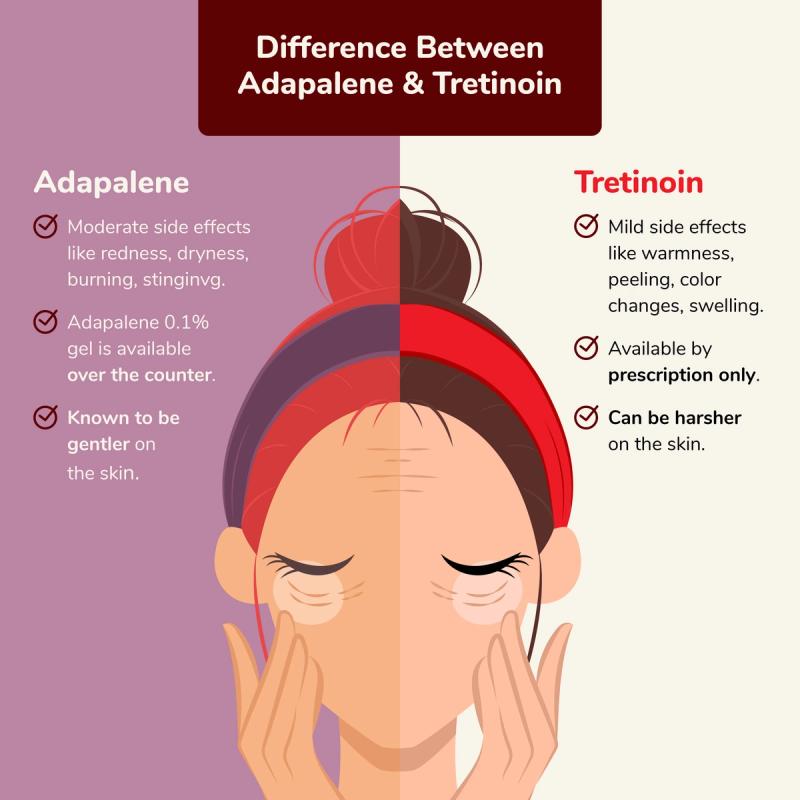
While both adapalene and tretinoin are retinoids, they do have some key differences.
Availability is the most obvious one. Adapalene 0.1% gel is sold over the counter, while every other form of adapalene and the stronger 0.3% strength require a prescription.13 All strengths and forms of tretinoin require a prescription.14
They also differ in strength and tolerability. Tretinoin is the more potent of the two and has a deeper body of research behind it, especially for sun damage and wrinkles.15 Adapalene is generally gentler and less likely to irritate skin, which is part of why it is often recommended as a starting point.16
Their approved uses differ slightly as well. Both are FDA approved to treat acne. Certain tretinoin products are also approved for fine wrinkling, dark spots, and rough skin caused by the sun, while using adapalene for signs of aging is considered off-label.17,18
How effective are adapalene and tretinoin?
Anti-aging and hyperpigmentation
In a study of the efficacy of adapalene 0.3% gel versus tretinoin 0.05% gel, both groups showed significant improvement in signs of aging, including photoaging and wrinkles, with little to no differences. The study concluded that adapalene and tretinoin were both safe, effective anti-aging skin treatments.19
Tretinoin has been studied for signs of aging longer than any other topical retinoid. A review of randomized controlled trials found it consistently improved wrinkling, uneven pigmentation, and dullness, with results showing up as early as one month and holding steady over two years of use.20
Acne
Both are proven acne treatments, and head-to-head research shows they perform similarly. A review of five randomized trials involving 900 people with mild to moderate acne found adapalene 0.1% gel reduced total blemish counts about as well as tretinoin 0.025% gel. Adapalene worked slightly faster in the first week and was better tolerated throughout.21 In a separate trial of 150 people, both treatments cut total, inflammatory, and noninflammatory blemishes by roughly 69% to 74%, and more than 70% of participants had clear or markedly improved skin.22
Topical retinoids like these are considered a cornerstone of acne treatment, and the American Academy of Dermatology recommends them as part of most acne treatment plans.23
How long do adapalene and tretinoin take to work?
Anti-aging and hyperpigmentation
Anti-aging results take patience with either option. Tretinoin may reduce fine wrinkles, but it can take three to four months, and sometimes up to six months, before you notice improvement. If you stop using it, the improvement may gradually fade.24 The 24-week comparison study of adapalene and tretinoin saw steady gains in wrinkles and pigmentation across six months of nightly use.25
Acne
Acne responds faster than wrinkles, but neither works overnight. With tretinoin, blemishes usually begin to clear after two to three weeks of regular use, though it can sometimes take more than six weeks.26 With adapalene, it typically takes eight to 12 weeks or longer to feel the full benefit, and skin may look worse before it looks better. Give either treatment a full three months before judging the results.27

Affordable online acne and anti-aging treatment.
Consult online with a skincare specialist and get acne or anti-aging prescriptions for less.
Get StartedDoes adapalene or tretinoin cause more irritation?
Adapalene has been shown in some studies to be gentler on the skin than tretinoin, especially in the over-the-counter 0.1% strength. In head-to-head trials, irritation was usually mild with both, but it was more common and more severe among people using tretinoin.28 A review of five randomized trials also found adapalene was better tolerated at every check-in.29
Tretinoin also comes with a risk of “tretinoin purge,” a short-term flare of breakouts, dryness, or flaking that can appear in the first few weeks after starting the medication.
Both retinoids heighten sun sensitivity. For best results, apply at night, follow with (or sandwich between) a nourishing moisturizer, and wear daily broad‑spectrum sunscreen to protect skin and curb irritation.
Are adapalene and tretinoin available over the counter?
Adapalene is available over the counter in 0.1% strength. Other strengths of adapalene, including the 0.3% strength, are prescription only.30 Tretinoin is available by prescription only.31
How do costs compare?
Over-the-counter adapalene 0.1% gel is a retail purchase, so the price varies by brand, tube size, and where you purchase it. It often costs between $10-$50.
Without insurance, adapalene 0.3% gel can cost anywhere from around $55 to over $12032, and tretinoin can range from around $30 to over $100.33
RedBox Rx offers prescriptions for adapalene 0.3% and tretinoin for $20 per month with the purchase of a three-month supply (a 45 g tube), no insurance required.
Can adapalene and tretinoin be used together?
Because adapalene and tretinoin are both retinoids that work in similar ways, using them together is not recommended. Layering two retinoids raises the risk of irritation without adding much benefit. Applying any other topical product to skin treated with adapalene can cause mild to severe irritation, so check with your provider before combining products.34
How to choose: adapalene or tretinoin
Adapalene and tretinoin each have advantages depending on your primary skin goals. Use these general recommendations to help guide conversations with your dermatology provider about which option may be right for you.
You may want to consider adapalene if:
You have very sensitive skin.
You want an over-the-counter starting point.
You’re looking for a gentler option for mild-to-moderate acne or anti-aging concerns.
You may want to consider tretinoin if:
You want the most effective, clinically proven results.
You have moderate to advanced signs of aging or persistent acne.
You’re ready for a prescription-strength treatment plan.
You want faster, more noticeable improvements.
How RedBox Rx can help
RedBox Rx makes acne and anti-aging treatments like adapalene and tretinoin easy and affordable.
Benefits of RedBox Rx include:
Transparent, affordable, flat rates for medications starting at $20/month.
$25 consultation with a U.S. licensed medical professional.
No insurance required. FSA and HSA eligible.
No office wait times or scheduling issues typical with physical medical practices.
FREE shipping directly to you. One-time, monthly, and quarterly subscriptions available.
Get started on your journey towards better skin withour online assessment for acne or anti-aging.